Division 7A
Keep every Division 7A loan schedule current
Set up each loan once. AccountKit applies the annual benchmark rate, calculates repayments and posts interest and dividend journals to Xero.
Included in the base subscription
What goes wrong today
The shortfall turns up after 30 June
The minimum yearly repayment gets worked out at year end from last year’s workbook, when it’s too late for the shareholder to make it up.
One spreadsheet per loan
Every loan has its own workbook, and each one needs the new benchmark rate keyed in by hand once the ATO publishes it.
The ledger drifts from the schedule
Interest and dividend journals are typed into Xero manually, so the loan balance in the file stops matching the schedule.
The schedule, year by year
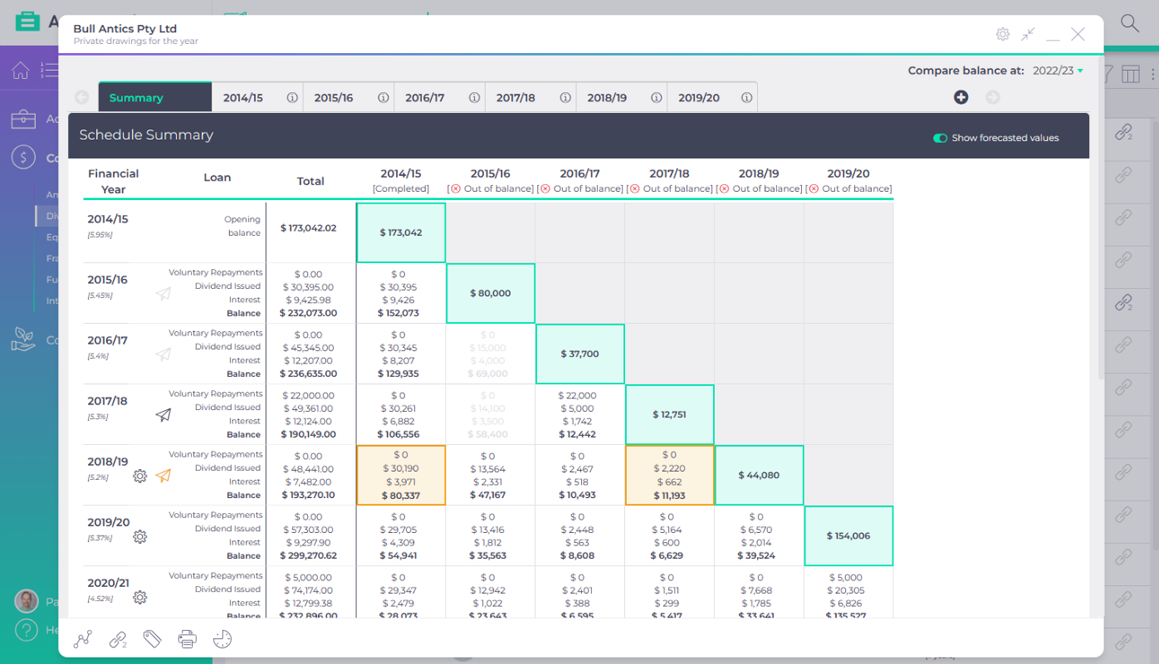
Scrub through a seven-year loan and watch the repayment move
Choose an income year. The opening balance, the ATO benchmark rate and the minimum yearly repayment recalculate from the year before, and a shortfall shows you what it costs.
 Division 7AInteractive preview · sample data
Selected year 2024–25 · Minimum repayment $34,195.28
Swipe the grid to compare the loan years
| Financial year | Loan | Total | 2020–21Loan 1 | 2021–22Loan 2 | 2022–23Loan 3 | 2023–24Loan 4 | 2024–25Loan 5 | 2025–26Loan 6 |
|---|---|---|---|---|---|---|---|---|
| 2020–21 | Opening balance | $180,000.00 | $180,000.00 new loan | |||||
| 2021–22(4.52%) | Repayments made | $30,600.00 | $30,600.00 | $80,000.00 new loan | ||||
| Minimum repayment | $30,568.63 | $30,568.63 | ||||||
| Interest | $8,136.00 | $8,136.00 | ||||||
| Balance | $237,536.00 | $157,536.00 | ||||||
| 2022–23(4.77%) | Repayments made | $44,700.00 | $30,900.00 | $13,800.00 | $37,700.00 new loan | |||
| Minimum repayment | $44,520.00 | $30,809.43 | $13,710.57 | |||||
| Interest | $11,330.47 | $7,514.47 | $3,816.00 | |||||
| Balance | $241,866.47 | $134,150.47 | $70,016.00 | |||||
| 2023–24(8.27%) | Repayments made | $56,600.00 | $33,900.00 | $15,300.00 | $7,400.00 | $12,751.00 new loan | ||
| Minimum repayment | $56,416.23 | $33,838.29 | $15,269.81 | $7,308.13 | ||||
| Interest | $20,002.35 | $11,094.24 | $5,790.32 | $3,117.79 | ||||
| Balance | $218,019.82 | $111,344.71 | $60,506.32 | $33,417.79 | ||||
| 2024–25(8.77%) | Repayments made | $45,500.00 | $20,000.00 | $15,500.00 | $7,400.00 | $2,600.00 | $44,080.00 new loan | |
| Minimum repayment | $59,570.74 | $34,195.28 | $15,463.00 | $7,398.48 | $2,513.98 | |||
| Interest | $19,120.33 | $9,764.93 | $5,306.40 | $2,930.74 | $1,118.26 | |||
| Balance | $235,720.15 | $101,109.64; repayment shortfall $14,195.28 | $50,312.72 | $28,948.53 | $11,269.26 | |||
| 2025–26(8.37%) | Repayments made | $73,400.00 | $39,500.00 | $15,400.00 | $7,400.00 | $2,500.00 | $8,600.00 | $154,006.00 new loan |
| Minimum repayment | $73,172.21 | $39,496.14 | $15,315.75 | $7,321.19 | $2,465.14 | $8,573.99 | ||
| Interest | $19,729.78 | $8,462.88 | $4,211.17 | $2,422.99 | $943.24 | $3,689.50 | ||
| Balance | $336,055.93 | $70,072.52 | $39,123.89 | $23,971.52 | $9,712.50 | $39,169.50 | ||
| 2026–27(8.77%) | Repayments made | $104,200.00 | $39,800.00 | $15,400.00 | $7,400.00 | $2,500.00 | $8,700.00 | $30,400.00 |
| Minimum repayment | $103,982.30 | $39,709.82 | $15,392.76 | $7,361.94 | $2,482.13 | $8,671.87 | $30,363.78 | |
| Interest | $29,472.12 | $6,145.36 | $3,431.17 | $2,102.30 | $851.79 | $3,435.17 | $13,506.33 | |
| Balance | $261,328.05 | $36,417.88 | $27,155.06 | $18,673.82 | $8,064.29 | $33,904.67 | $137,112.33 |
New loanRepayment shortfallSample loans · AUD · scroll across on smaller screens
- Opening balance
- $111,344.71
- Minimum repayment
- $34,195.28
- Repaid by 30 June
- $20,000.00
- Closing balance
- $101,109.64
Section 109E treats the shortfall as a dividend paid by Harbour Group Pty Ltd at 30 June 2025, to the extent of its distributable surplus. The balance stays in the loan.
About this example and calculation
$180,000.00 loan from Harbour Group Pty Ltd to Shareholder A, not repaid at 30 June 2021. The summary includes six illustrative loan vintages. The selected-year figures above follow this original loan; the Total column combines all six. Additional loans use the same repayment formula and round-up policy.
Benchmark rates: ATO, income years ended 30 June 2022 to 2027. Minimum yearly repayment: ITAA 1936 section 109E(6). Repayments are assumed to be made on 30 June. Year seven (2027–28) uses the rate the ATO sets before that income year starts.
Minimum yearly repayment = opening balance × benchmark rate ÷ (1 − (1 ÷ (1 + rate)) raised to the remaining loan term).
Interactive demonstration with sample data, based on the AccountKit interface.
Who it’s for
Built for practices with private company groups
Practices whose clients run a private company alongside a family trust or individual shareholders, where money moves from the company to the people who own it. One client group can carry several loans at once.
How often it comes round
Every income year, for every loan, for up to seven years unsecured or twenty-five secured over real property.
- From 1 July
- The new benchmark rate applies to every loan.
- By 30 June
- The minimum yearly repayment has to be paid.
- At year end
- Interest is journalled and any shortfall dealt with.
- Before lodgement
- A written agreement covers any new loan made in the year.
Posts to Xero
The dividend and interest journals go straight to Xero
Once the schedule is right, the journal leaves AccountKit and lands in the company’s Xero file, so the loan account and the schedule stay the same number.
Journal previewInteractive preview · sample data| Account | Debit | Credit |
|---|---|---|
| Loan to Shareholder A (Div 7A) | 9,764.93 | |
| Interest income | 9,764.93 | |
| Total | 9,764.93 | 9,764.93 |
Interactive demonstration with sample data, based on the AccountKit interface.

Xero · Harbour Group Pty Ltd
Manual journal, 30 Jun 2025
Posted
Illustrative journal with sample entities. Account names are examples.
Related tools
Tools that sit beside this one
- Compliance
Inter-entity loan tool
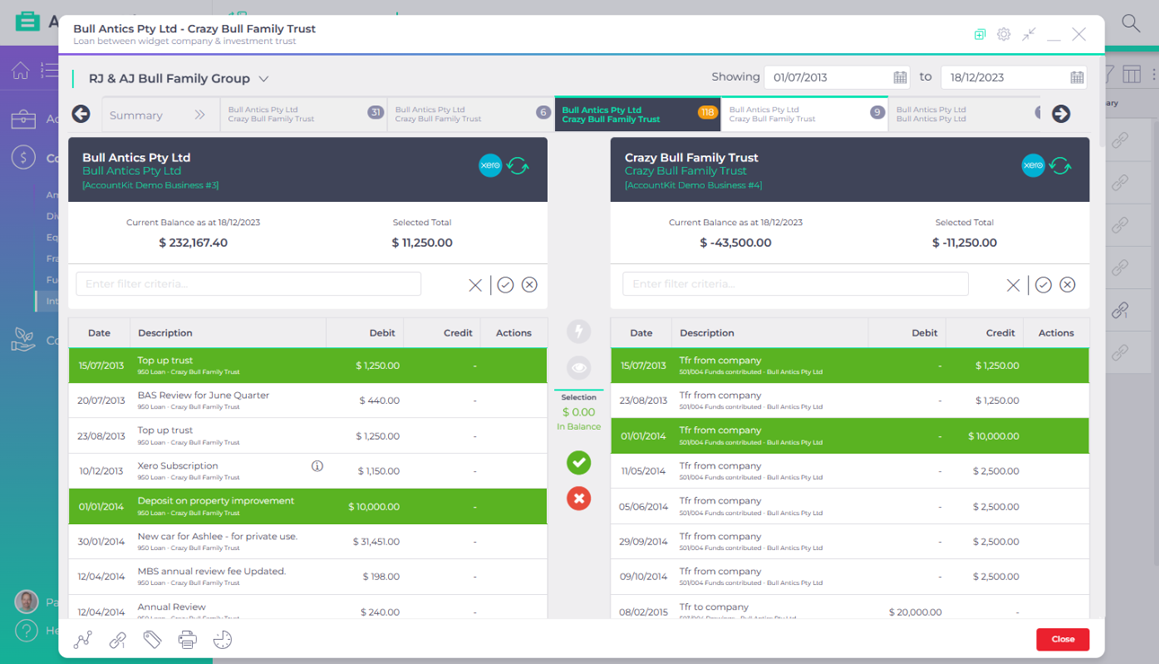
Entries matched between entities across the group, with the unreconciled balance journalled.Watch the ledgers match - Compliance
Equipment finance
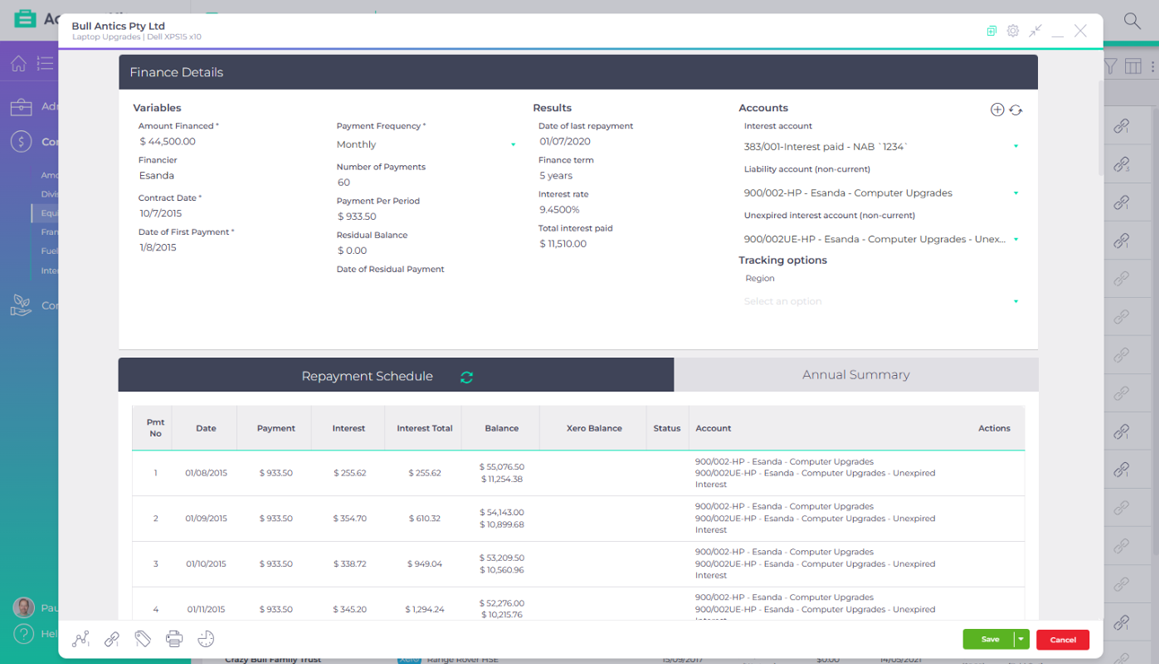
Regular or irregular finance schedules that post their entries and reconcile through the year.Watch the schedule build
Also in the toolkit
- Franking account registerFranking account balances for every client company, tracked in one register.
- Client mapping toolDiagrams of client structures, software and processes, with client details kept in sync.
The heart of your firm
Run this year’s Division 7A schedules in AccountKit
Start a free 14-day trial and set up a loan for a real client, or book a demo to see the schedule with the team.